


The media landscape is restructuring in real time—after years of fragmentation and noise, the pieces are starting to organize themselves into something coherent, intentional, and disciplined. As we see it, the industry is finally coordinating solutions. At Stella Rising, we've tracked four major shifts reshaping how brands in beauty, health, and food and beverage connect with consumers and drive profitable growth. The good news: the media fundamentals still hold. The opportunity is to know exactly how to apply them.
WHY 2026 IS DIFFERENT (BUT THE JOB IS EXACTLY THE SAME)
The media industry loves a funeral. Every year, something is declared dead or dying: TV, retail, email, the CMO, brand, performance, you name it.
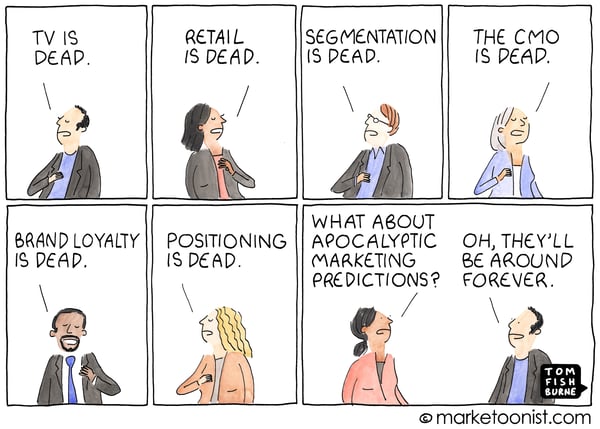
Yet brands keep being built, categories keep growing, and consumers keep doing what they have always done: paying attention to things that matter to them—and ignoring everything else.
2026 is not the year that EveRyThINg ChAnGeS. It is the year that the last decade of change finally comes into focus. The pipes and placements are different. The fundamentals of how marketing creates value are not. The brands that will win this year are not the ones “chasing channels” fastest; they are the ones applying classic principles of brand-building and sales activation to a new, messier, more integrated system.
At Stella Rising, here is the opportunity we see for our clients in beauty, health, and food and beverage: navigating structural shifts in media without losing the plot on what actually drives growth.
THE FUNDAMENTALS HAVEN'T CHANGED. THE CHANNELS HAVE.
Let's start with the thing worth saying out loud: structural shifts in media channels do not change the fundamentals of how marketing creates value, which is by building brands. Nike, starting in 2020, famously retreated from brand building, only to course-correct in 2024; that four-year blip turned into a highly expensive case study in what happens when you stop investing in brand.
Brands are still built over years. Penetration still beats loyalty. Share of voice still matters. Creativity still works hardest when it is consistent and distinctive. And brands that balance long- and short-term aims outperform those that chase either extreme.
The fundamentals of brand-building, sales activation, and disciplined measurement are not changing. What is changing is where people consume media and how we buy it.
TREND #1: VIDEO DOMINANCE IS NOT NEW, BUT WHERE IT LIVES HAS CHANGED EVERYTHING
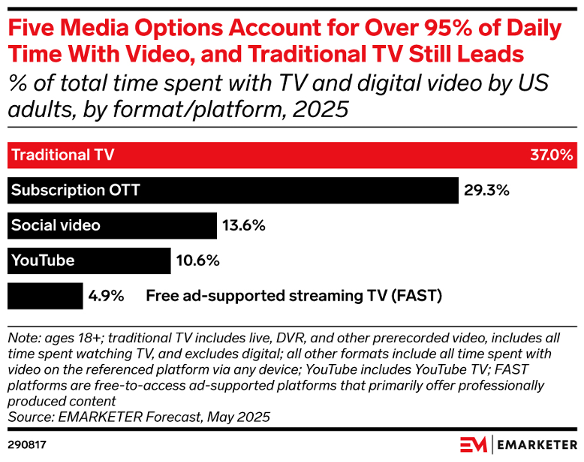
Digital now dominates daily media time, and it's still growing. U.S. adults will spend nearly 13 hours a day with media in 2026, led by a multitude of digital options all competing for attention. The most time is still spent on a TV screen. It's just coming through a very different pipe.
Digital video's incredible surge has more than compensated for the slow decline of traditional TV. TV time has been cut roughly in half over the past decade, yet total time with video has ballooned to nearly seven hours. CTV and YouTube reshaped how consumers experience video altogether; that shift is about convenience, flexibility, and content.
There's also a real perception gap: marketers consistently overestimate digital video and undervalue the TV screen. Our strategic plans ensure we meet viewers where they are, across an expanding range of services and screens. We plan for the screen first, then the delivery mechanism. CTV and YouTube aren't replacements for TV, they're powerful complements that extend reach, especially to light TV viewers and younger audiences. When we treat YouTube with the same brand-building rigor we bring to TV- adequate budgets (with quality creative and sustained campaigns) it delivers both awareness and activation. The fundamentals don't change.
The battle is for the TV screen, not for whether the signal arrives through a linear feed, a CTV app, or a YouTube interface. For us, this distinction matters enormously:
- We treat the TV screen as the primary video canvas, then decide whether linear, CTV, YouTube, or a mix best reaches your brand audience at an effective cost.
- We cannot underestimate TV’s role in brand building and overestimate how much digital video you are really buying; the perception gap between “what we think we are doing” and “what the schedule actually looks like” is still wide.
- Recognize that CTV is powerful but imperfect: tech fees inflate CPMs, household-level targeting is not the same as individual-level relevance, and unmanaged frequency can be brutal. We are ON TOP of these challenges for our clients—nonstop.
CTV & TV: The Stella Way of Thinking
- The core issue in CTV is that most brands are still buying it like digital, which pushes everything toward biddable, lower-funnel tactics and leaves real brand and demand value on the table.
- Part of what makes this hard is measurement. TV and CTV advertisers aren't bad at it, but years of digital have conditioned everyone to expect instant feedback and short-term spikes. These channels build demand over time and are easily misjudged in a two-week window.
- Used well, TV and CTV are full-funnel: capable of driving near-term response while compounding impact across brand, search, retail velocity, and overall revenue growth over quarters.
- Getting there requires three things from the start: a clear anchor metric everyone agrees on, enough budget to generate signal and lift, and tight alignment between brand and performance teams so TV, CTV, and digital are planned and measured against the same growth objectives.
TREND #2: COMMERCE MEDIA HAS GROWN UP: IT'S NOW A FULL FUNNEL ENGINE
Retail media is projected to grow 12% in 2026, expanding nearly 30% faster than the overall ad market. Stella Rising clients, enterprise brands in particular, are growing in lockstep with retail media, shifting strategies and budgets to accommodate this space.
Commerce media is the new shelf and the new ad unit, as consumers discover products on platforms like Target’s Roundel, as much as through traditional media. The digital shelf, conversion- and action-oriented, is where shoppers decide what goes in their cart. But the digital shelf is no longer only a bottom-funnel, conversion-focused tactic: it now spans search, onsite display, off-site programmatic, CTV, and in-app. It's a full-funnel engine within itself.
This is powerful! But for media planners, a little painful, too. Here’s why:
- Powerful: retail media now spans search, on-site display, off-site programmatic, CTV, and in-app formats, giving marketers a genuinely full-funnel system wrapped around literal sales data.
- Painful: only a small minority of decision-makers would describe their commerce media programs as truly advanced. Most brands now wrestle with multiple retail media networks, conflicting taxonomies, inconsistent reporting, and siloed teams.
That complexity is exactly why we restructured our teams around the way retail media actually works. At Stella Rising, our search team—comprised of both paid and organic—works in close collaboration with our social, brand, and performance teams, not in separate silos. Retailer signals inform media strategy from the start, so our clients aren't managing disconnected handoffs between channel specialists. The result is retail media treated as a disciplined growth channel, not a checkout-adjacent add-on.
The strategic question for 2026 is not, “how much should we spend on retail media?” Instead, it is, “what role should commerce media play at each stage of our brand and sales funnel, and how do we wire it into everything else we do?”
TREND #3: CREATORS ARE THE CONNECTIVE TISSUE
Creator ad spend is projected to hit $43B by 2026. Unilever, as an example, went all-in, directing 50% of their ad budget to social and partnering with 300,000 influencers: a 20x increase. That's not a test; that's a fundamental strategic shift that's raised the stakes for everyone.
Why does it work? Creator partnerships are a direct line to trust and intimacy. 40% of consumers consult an influencer before making a purchase. Gen Z views their favorite creators the way they view their friends, and know what those creators wear, eat, and buy. Brands borrow that trust when they align with credible creators. And crucially, creator content spans the full funnel within a single piece of content—awareness, consideration, and conversion, all at once.
Creator content is also extending meaningfully into retail media, with networks like Amazon and Walmart partnering with creator platforms so that ads follow shoppers from social feeds directly into the retail environment. The line between discovery and purchase is blurring fast. 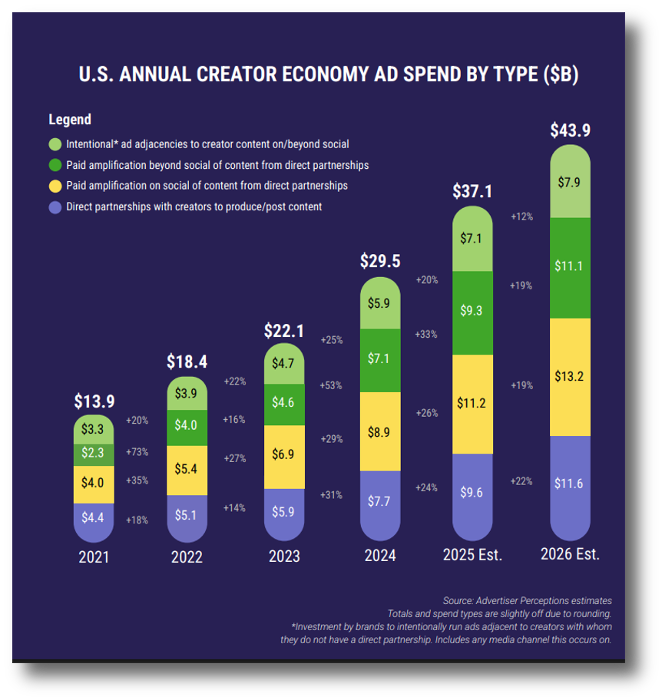
TREND #4: MEASUREMENT IS MODERNIZING: STELLA IS AHEAD OF IT
The measurement landscape is crowded, fragmented, and still incomplete. The Interactive Advertising Bureau said it best at their Annual Leadership Meeting: “marketing measurement is under strain. Signals are disappearing. Data is fragmented across the industry. Outcomes vary by definition. And as AI accelerates how measurement is built and scaled, confidence in the answers has not kept pace.” Dozens of tools purport to address this “fundamentally broken” measurement infrastructure, but they don’t communicate with each other and leave significant investment dollars on the table because no one can agree on what's working.
Our answer has been Marketing Mix Modeling, a solution we’ve delivered for our high-growth digital brands for years.
An MMM is the only method that shows both the forest and the trees. A statistical method that analyzes all the variables driving your business (media channels, seasonality, pricing, competition, and more) an MMM shows exactly what’s contributing to business sales and in what proportion. Our favorite analogy is that of an expert baker, who can taste a cake and identify every ingredient and its proportion; an MMM does the same for your business results.
An MMM does three things that the current obsession with last-click and platform-specific attribution cannot in that it:
- Quantifies the contribution of each major driver to total sales, not just to tracked conversions.
- Separates long-term brand effects from short-term activation, allowing for budget setting with both in mind.
- Provides a stable frame of reference that does not break every time a platform changes a policy or a browser blocks another cookie.
Our analytics team has won awards for MMM work, and that track record reflects something deliberate: sophisticated analytics as the backbone of how we prove value for clients, not an afterthought.
The TLDR for 2026: the channels are changing fast, but the job remains the same. Build brands, activate sales, and measure what matters—across video, retail media, creators, and everywhere in between.
2026 will not be won by brands that have the longest channel list or the most logos on their tech stack slide. It will be won by brands that:
- Start with the fundamentals of brand-building and sales activation, then choose channels accordingly.
- Treat “total video” as one system, designed around the screen and the creative job to be done.
- Integrate commerce media and creators into the core of their strategy, not as add-ons.
- Use rigorous, business-level measurement to make trade-offs, not to decorate presentations.
At Stella Rising, we've always believed the best strategies start with the consumer and end with accountability. The trends are different this year. The discipline isn't.
Looking to position your brand to win in 2026? Connect with us.
Additional Sources: iab 2026, Advertising Perceptions 2026
COMMENTS